Definitely worth checking this out. Recent molecular studies have identified substantial fungal diversity in indoor environments. Fungi and fungal particles have been linked to a range of potentially unwanted effects in the built environment, including asthma, decay of building materials, and food spoilage. The study of the built mycobiome is hampered by a number of …
We are excited to announce that the Alfred P. Sloan Foundation will be sponsoring a symposium at the National Council for Science and the Environment (NCSE) Conference and Global Forum in Washington, DC from Jan 24-26, 2017 (http://www.ncseconference.org/). The 2017 conference has the theme “Integrating Environment and Health” and typically brings together between 1,000-1,200 attendees …
Proceedings of the Emory University’s May 2016 workshop on Legionella are now available online through the Emory Center for Public Health Preparedness and Research’s website (here) or on YouTube via Emory University’s official YouTube channel (here). Held on May 25 – 26, 2016 in Atlanta, GA, the workshop entitled “From Watersheds to Shower heads: A Workshop on Legionella” …
So last Spring quarter Ashley Vater and myself ran a class where we went from abalone feces swabs on the first day, to a draft of a Genome Announcement on the last day… written by the students. With 16 students in the class we ended up with 10 sequenced/assembled/annotated genomes. A full description and summary …
Interesting short new paper in arXiv: [1609.05763] Integrating citizen science with online learning to ask better questions Vineet Pandey, Scott Klemmer, Amnon Amir, Justine Debelius, Embriette R. Hyde, Tomasz Kosciolek, Rob Knight Abstract: Online learners spend millions of hours per year testing their new skills on assignments with known answers. This paper explores whether framing research questions …
Microbes and buildings The Microbiome of Green Design: Sustainable building practices may have unforeseen consequences for microbial communities and human health – Carolyn Beans – BioScience ($40 for 1 day) Just as our bodies teem with microbial life, so, too, do the homes, offices, schools, and other indoor spaces where we spend the majority of our …
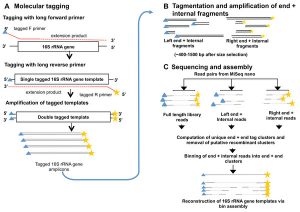
Definitely worth checking this one (from Burke and Darling) out if you do microbial diversity studies … Background The bacterial 16S rRNA gene has historically been used in defining bacterial taxonomy and phylogeny. However, there are currently no high-throughput methods to sequence full-length 16S rRNA genes present in a sample with precision. Results We describe …
New software/tool of possible interest: Source: MetaMLST: multi-locus strain-level bacterial typing from metagenomic samples Software: http://segatalab.cibio.unitn.it/tools/metamlst/ Abstract: Metagenomic characterization of microbial communities has the potential to become a tool to identify pathogens in human samples. However, software tools able to extract strain-level typing information from metagenomic data are needed. Low-throughput molecular typing schema such as Multilocus …
Collecting together here some reports from the Lake Arrowhead Microbial Genomes Meeting David Coil’s summaries Lake Arrowhead Microbial Genomics #LAMG16: Day 4 and Random Thoughts Lake Arrowhead Microbial Genomes #LAMG16: Day 3 Lake Arrowhead Microbial Genomics #LAMG16 Report: Day 2 Lake Arrowhead Microbial Genomics #LAMG16 Report: Day From me microbiology of the Built Environment session …
Only three talks on the last day. First up was Jordan Parker “Microbiome Course-based Undergraduate Research Experiences (CUREs) Benefit Students and Faculty”. Great talk about how we need to move from cookbook labs to discovery-based research, talked about the “I Microbiologist” textbook. The challenge is to scale research to class-sized groups. She described the competency-based …