Posting this which I got from Jason Stajich I am passing along this request from the EuPathDB/FungiDB team. There are opportunities for UK and US placement of a person. Please feel free to forward to suitable candidates. There is hope that a person with fungal biology experience who wants to focus on outreach and community …
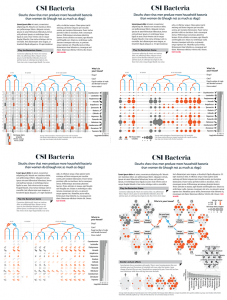
Designers Martin Krzywinski and Barbara Jeannie Hunnicutt provide a peek behind the scenes, and explain how they developed a data visualization based on bacterial genome information derived from dust. Source: The Evolution of a Scientific American Infographic: Secret Life in Household Dust – Scientific American Blog Network This is an absolutely fascinating look behind the …
What’s new in the intersection of microbiology and human use of the environment? Here are some recent papers and their abstracts. The first paper is important because it describes the microbiological conditions of the waters that will be used in the 2016 Olympics: Environmental and Sanitary Conditions of Guanabara Bay, Rio de Janeiro – Giovana …
As Beijing experiences its first “Red Alert” smog emergency, an aptly-timed bit of quirky performance art is making the round on Chinese social media and the English-language press today. A artist from Shenzhen who calls himself “Brother Nut” spent 100 days walking around Beijing with an industrial vacuum cleaner. He then collected dust into a …
Autumn is not just a beautiful season in which multicolored leaves fall to the ground from their branches. It is also a good time for all kinds of microbes to flourish with the new addition of delicious leaf litter nutrients. A new paper from Irga et al studies the connection between the fungi found on leaf litter and …
Just a quick note that the meeting report from the Sloan-funded symposium “Microbiology of the Built Environment” held at Healthy Buildings Europe 2015 is now available in Microbiome. Summary below: Excess or abnormal microbiological activity is both a cause and a consequence of unhealthful indoor environments. Building research, investigations, and remediation must identify compromised buildings …
As buildings move forward in an attempt to become more “green,” it is important to continue to assess how the microbiology changes with these new systems. A recent study from Keely et al used high-throughput pyrosequencing to look at what microbes live in the different points in grey water systems. The sampling efforts were split into …
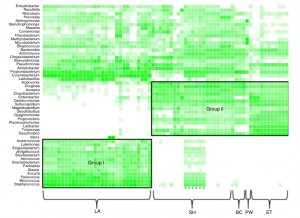
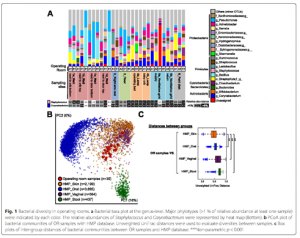
Infants born via c-section have a microbiome community composed mostly of skin bacteria [1-3], but the source of these skin bacteria is unknown. People quickly shed bacteria into their environment, leaving their own bacterial signature in a room within hours [4]. Do hospital operating rooms harbor skin bacteria that could colonize c-section delivered infants? A …
The G-20 would be an ideal forum in which to take international action against antimicrobial resistance, writes Jim O’Neill. This is definitely worth a read: How to stop antibiotic resistance threatening global growth Jim O’ Neill (who is the Commercial Secretary to the UK Treasury) writes about how the report from the G20 meeting in Antalya, …
Adding to the list of common surfaces in the built environment that are harboring unique microbial communities — solar panels! If you build a smooth surface exposed to the sun, will they come, like poolside sunbathers vying for the best lounge chairs? A study by Pedro Dorado-Morales and crew came at this question from multiple sides: they …